
Meta Ad Library: What Smart Advertisers Track
If you buy media, run an agency, manage e-commerce growth, or build competitor intelligence workflows, the Meta Ad Library is one of the fastest ways to understand what is happening across Facebook and Instagram right now.
The challenge is not access. The challenge is turning raw ad visibility into usable intelligence.
Most teams open the Meta Ad Library, search a competitor, scroll a few ads, and leave with surface-level observations. Smart advertisers go further. They track patterns in creatives, offers, angles, campaign velocity, regional coverage, launch timing, and repetition. They use that information to discover winning products, identify active campaigns early, and make better decisions before budgets are spent.
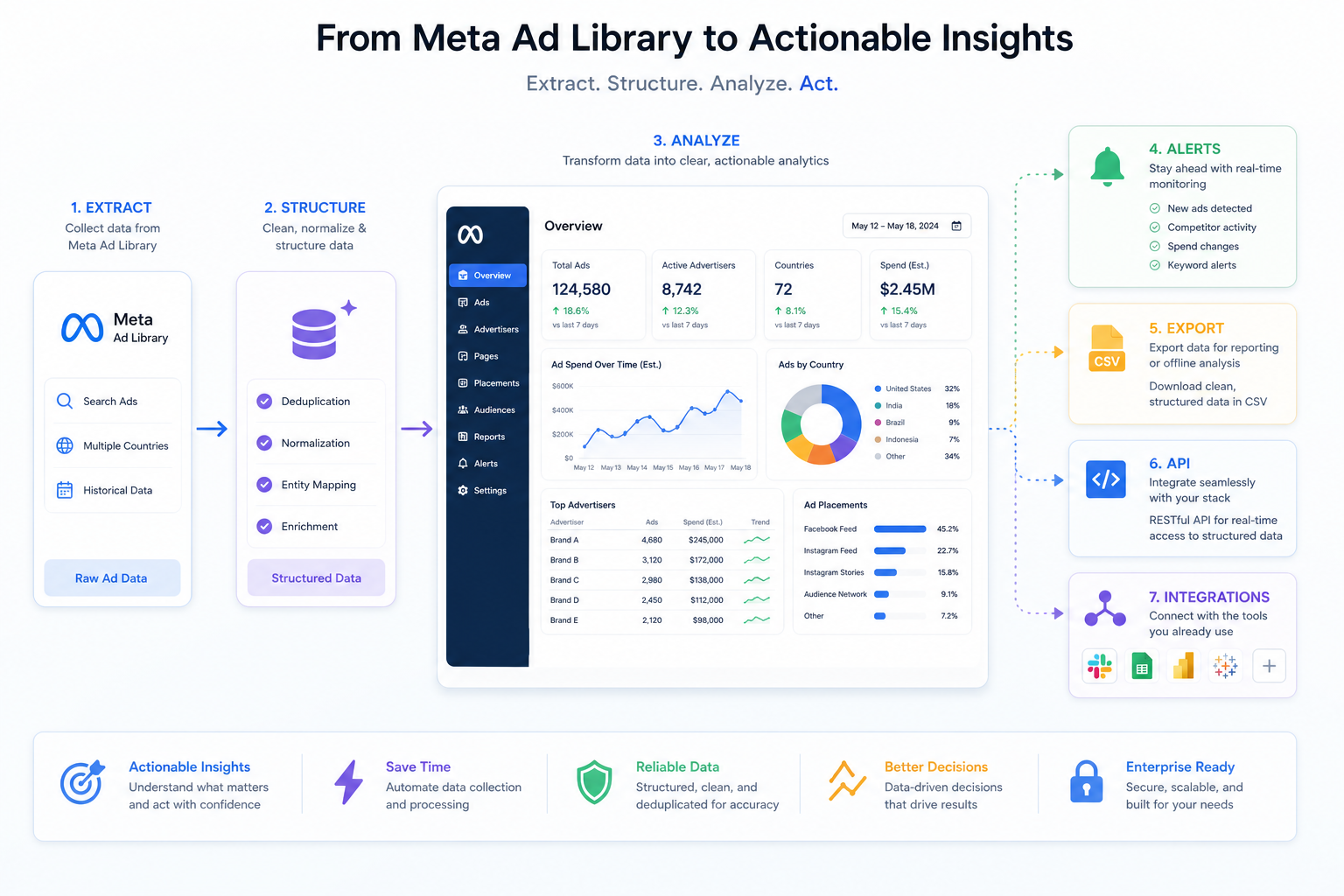
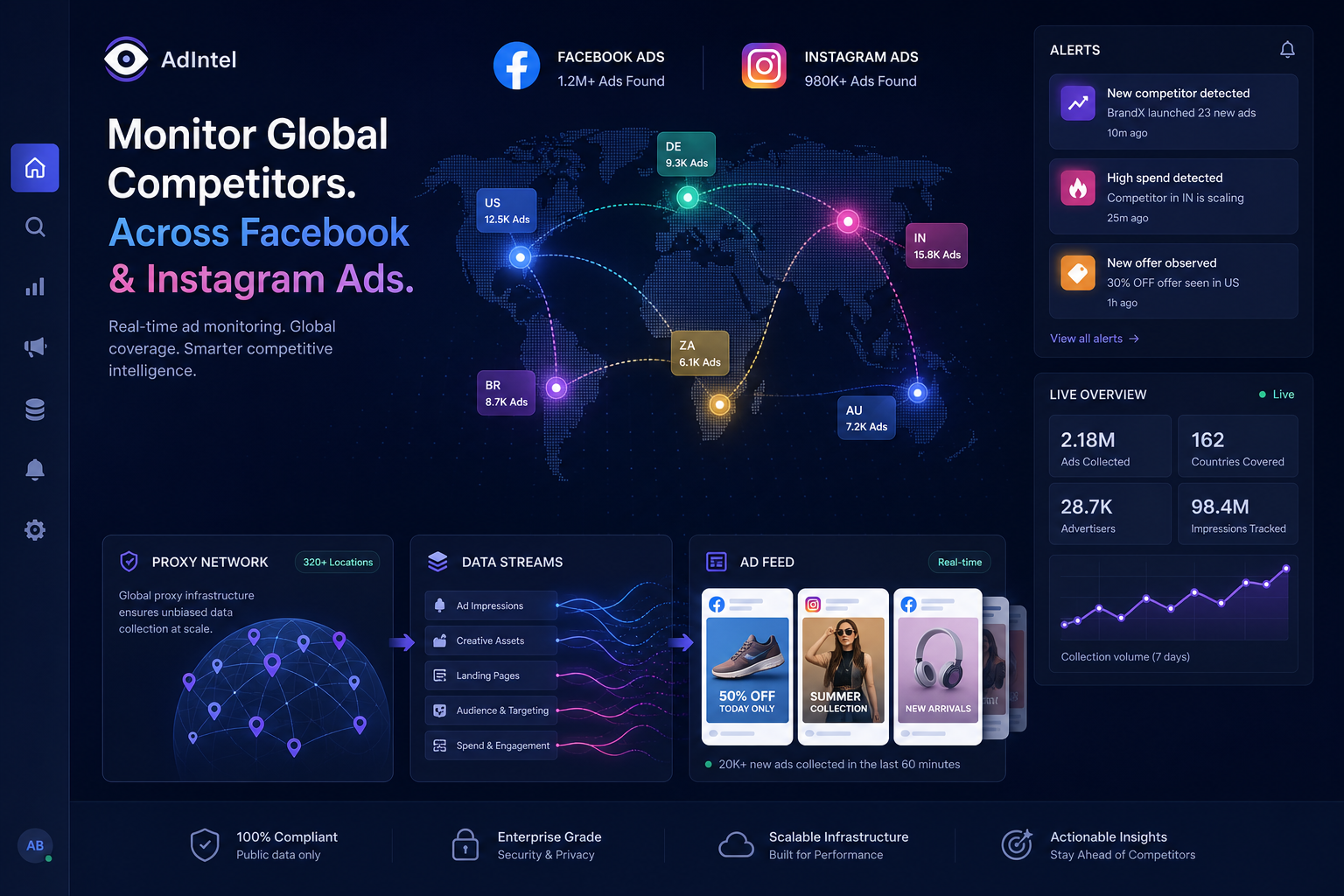
For technical teams, the next problem is scale. Manual review does not hold up when you need clean, structured, deduplicated ad data across many brands and GEOs. That is where platforms like Adspyre become essential: fast extraction of Facebook and Instagram ads in under 30 seconds, built-in residential proxy rotation, global Meta ad coverage without geographic restrictions, a no-code dashboard for non-technical users, and a production-grade API for analytics, automation, and monitoring at scale.
“The Meta Ad Library is a public database that provides transparency into advertisements running across Meta’s platforms, including Facebook, Instagram, Messenger, and the Audience Network.” – Source
“Companies with advanced marketing and sales capabilities tend to experience revenue growth 30% greater than the average company within their sector.” – Source
What the Meta Ad Library Actually Is
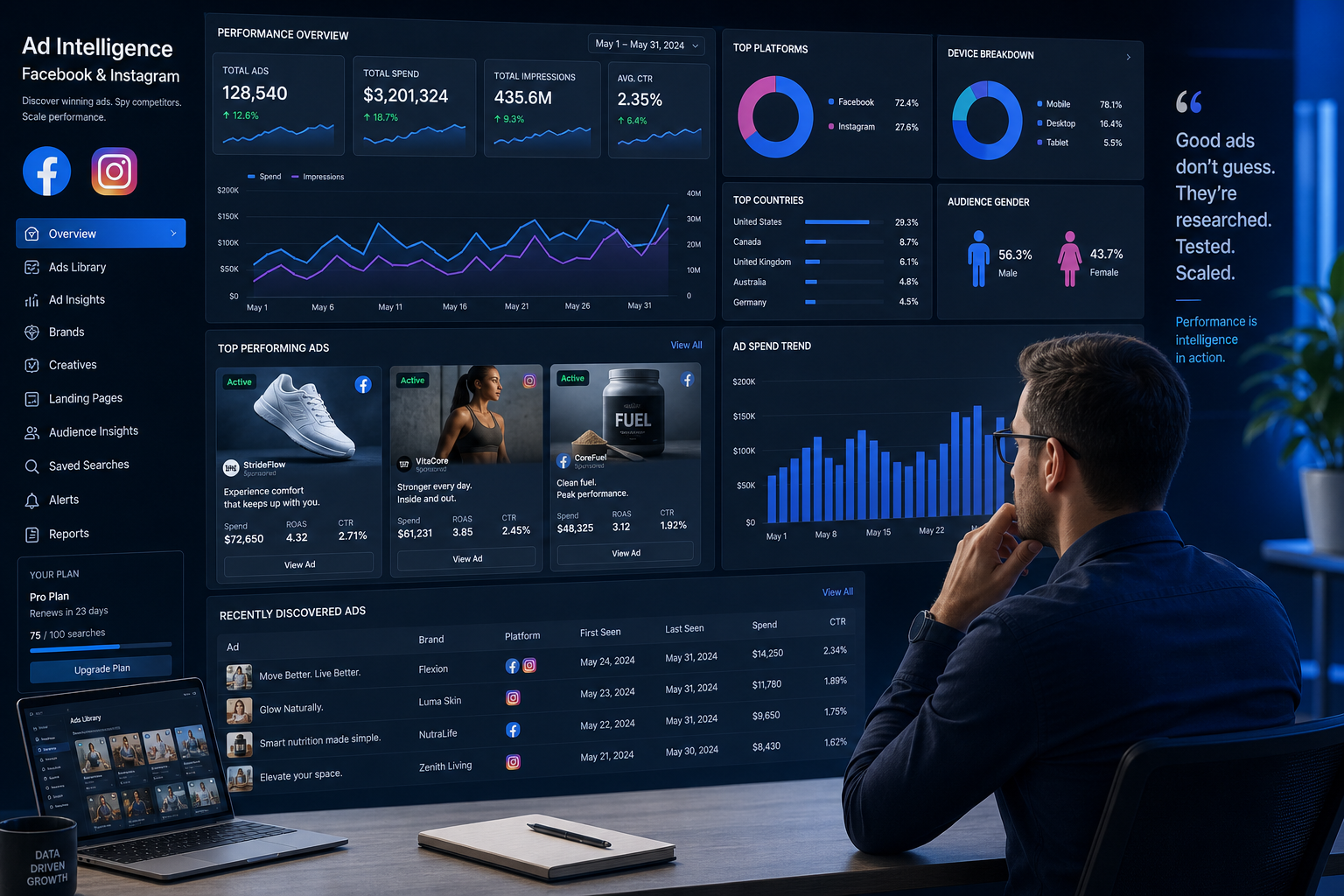
The Meta Ad Library is Meta’s public transparency database for ads running across its ecosystem. It lets anyone search advertisers and view active ads on Facebook and Instagram, along with certain additional details depending on ad type and region.
For marketers, that means you can inspect:
-
Active ad creatives
-
Ad copy and messaging
-
Advertiser pages
-
Start dates
-
Platform placement visibility
-
In some cases, additional transparency data tied to regulation or political content
What it does not give you is equally important:
-
No direct ROAS
-
No conversion data
-
No click-through rate
-
No complete targeting logic for standard commercial ads
-
No clean deduplicated export workflow by default
-
No always-on competitor monitoring experience for scaled teams
That gap between visible ad data and actionable intelligence is where smart operators build an advantage.
Why Marketers Use the Meta Ad Library
The Meta Ad Library matters because Facebook and Instagram remain two of the most creative- and offer-driven paid channels in performance marketing. If a competitor is testing aggressively, their ads often reveal:
-
New product launches
-
Seasonal promotions
-
Funnel offers
-
Creative formats that are being scaled
-
Messaging shifts
-
Geographic expansion
-
Audience segment experimentation
-
Brand positioning changes
For media buyers and agencies, this reduces guesswork.
For e-commerce teams, it helps surface winning products and successful offer structures.
For growth teams, it shows which creative themes keep getting repeated, which is often a strong proxy for what is working.
For developers and intelligence teams, the Meta Ad Library is a rich signal source – but only if the data can be collected reliably and transformed into structured output.
What Smart Advertisers Track Inside the Meta Ad Library
1. Creative Volume
The number of active ads tells you a lot. A competitor running 5 ads is in a different mode than one running 500.
High volume often signals:
-
Heavy testing
-
Large spend capacity
-
Multi-audience segmentation
-
Multi-country deployment
-
Mature creative operations
Low volume may indicate:
-
A narrow evergreen strategy
-
Budget constraints
-
A recent pause
-
Early-stage testing
What matters is not just the number itself, but the trend over time.
2. Creative Repetition
When the same creative angle appears across multiple ads, formats, or variants, pay attention. Repetition is often evidence that the advertiser is scaling a winning concept.
Look for repeated patterns in:
-
Hooks
-
Headlines
-
UGC styles
-
Before/after framing
-
Discount structures
-
Problem-solution language
-
Testimonial-led storytelling
3. Offer Strategy
Offers are usually the fastest signal of commercial intent.
Track:
-
Percentage discounts
-
Buy-one-get-one promotions
-
Free shipping thresholds
-
Bundles
-
Trial offers
-
Lead magnets
-
Limited-time urgency
-
Seasonal sale cadence
If you see an offer return repeatedly, it likely converts.
4. Product Prioritization
Many brands advertise dozens or hundreds of SKUs, but only a few products get sustained paid support.
The Meta Ad Library can reveal:
-
Hero products
-
Upsell products
-
New launches
-
Market repositioning
-
Inventory-clearing campaigns
-
Category-level emphasis
For product researchers and dropshippers, this is one of the most valuable signals in the entire platform.
5. Messaging Angles
This is where top advertisers extract strategic value.
Track which angles a competitor is pushing:
-
Price-first
-
Premium positioning
-
Convenience
-
Speed
-
Transformation
-
Problem awareness
-
Social proof
-
Scarcity
-
Authority
-
Lifestyle aspiration
A change in messaging often shows up in ads before it appears across the rest of the brand’s site or lifecycle marketing.
6. Format Mix
Different creative formats suggest different campaign goals.
Watch for usage of:
-
Static images
-
UGC video
-
Motion graphics
-
Carousels
-
Reels-style vertical video
-
Founder videos
-
Testimonial clips
-
Product demos
A shift from static to video-heavy often indicates a more aggressive optimization phase.
7. Launch Timing
When did the ad start running? Timing helps you understand campaign cadence.
Patterns to monitor:
-
Weekly launches
-
End-of-month promo pushes
-
Holiday ramp-ups
-
New collection drops
-
Flash sale windows
-
Always-on evergreen campaigns
8. Geographic Presence
Some advertisers run globally. Others localize aggressively.
Tracking countries and market visibility can reveal:
-
Expansion into new regions
-
International product-market fit
-
Localization strategy
-
Regional promo sequencing
This matters because not all monitoring solutions handle GEO coverage well. Adspyre is particularly strong here, with global Meta ad coverage without geographic restrictions, making it easier to monitor advertisers across regions instead of relying on fragmented manual checks.
What the Meta Ad Library Shows vs. What Smart Teams Need
|
Capability |
Meta Ad Library |
What serious teams usually need |
|---|---|---|
|
View active ads |
Yes |
Yes |
|
Search advertiser pages |
Yes |
Yes |
|
Manual creative review |
Yes |
Yes |
|
Structured deduplicated data |
Limited |
Essential |
|
Bulk extraction |
Limited |
Essential |
|
Automated competitor monitoring |
No native workflow |
Essential |
|
Real-time alerts |
Limited |
Essential |
|
API access for workflows |
Limited by use case |
Essential |
|
CSV/Excel export |
Not workflow-friendly |
Essential |
|
GEO-flexible monitoring |
Partial/manual |
Essential |
|
Enterprise uptime and reliability |
Not built for your ops layer |
Essential |
That is the operational difference between using the Meta Ad Library and building a repeatable ad intelligence system.
The Biggest Content Gap Most Articles Miss: Raw Visibility Is Not Enough
Most articles about the Meta Ad Library stop at “search your competitor and review their ads.” That advice is incomplete.
The real value comes from building a process around:
-
Extraction
-
Deduplication
-
Monitoring
-
Alerting
-
Historical comparison
-
Structured analysis
-
Team-wide access
Without that, insights disappear into screenshots, spreadsheets, and Slack messages.
This is exactly where Adspyre creates leverage:
-
Extract Facebook and Instagram ads in under 30 seconds
-
Receive clean, deduplicated structured data
-
Monitor competitors 24/7
-
Use real-time webhooks and Telegram alerts
-
Export via CSV and Excel
-
Work from a no-code dashboard or a production-grade API
-
Avoid external proxy costs with built-in residential proxy rotation
-
Reduce engineering maintenance compared to custom scraping scripts
-
Run on enterprise-grade infrastructure with anti-bot bypass and browser emulation
-
Depend on 99.99% SLA uptime
For teams that need speed and reliability, this is the difference between passive browsing and operational intelligence.
How to Analyze a Competitor in the Meta Ad Library Like an Expert
Step 1: Start With the Advertiser, Not a Single Ad
Do not over-index on one creative. Review the advertiser’s broader footprint.
Ask:
-
How many ads are live?
-
How many creative concepts are repeated?
-
Are there multiple offers?
-
Are there clear audience variants?
-
Is the brand pushing one hero product or many?
Step 2: Group Ads by Angle
Cluster ads into themes such as:
-
Discount-led
-
Educational
-
UGC testimonial
-
Founder story
-
Product demo
-
Comparison
-
Seasonal
-
Retargeting-style urgency
This gives you a strategy map rather than a pile of ad examples.
Step 3: Identify What Appears to Be Scaling
Signals that an ad concept may be working:
-
Repeated variants with small copy changes
-
The same offer in multiple formats
-
Similar hooks across several ads
-
Long visibility window
-
Broad deployment across creatives
Step 4: Track Changes Over Time
One snapshot is useful. Continuous tracking is powerful.
You want to know:
-
What is newly launched
-
What disappeared
-
What has stayed live the longest
-
What offer replaced another
-
Which angles are getting more investment
This is where always-on monitoring beats occasional manual review every time.
Step 5: Convert Findings Into Action
Use the insights to improve:
-
Creative briefs
-
Product selection
-
Market positioning
-
Offer testing
-
Landing page messaging
-
Geo expansion strategy
-
Competitor reporting for clients
Meta Ad Library for Different Types of Advertisers
For Media Buyers
Use it to spot:
-
Creative fatigue patterns
-
Fresh hooks competitors are testing
-
Format shifts
-
Offer pressure in the market
-
Seasonal bursts in spending intent
For Agencies
Use it to:
-
Build competitive reports faster
-
Support pitches with real ad evidence
-
Track client competitors continuously
-
Surface creative opportunities proactively
For E-commerce Operators
Use it to find:
-
Winning products
-
Bundle strategies
-
High-frequency promo mechanics
-
Product-market trend signals
-
Brands scaling similar catalog types
For Growth and Intelligence Teams
Use it to create:
-
Market maps
-
Competitor launch alerts
-
Messaging trend reports
-
Creative saturation analysis
-
Brand activity benchmarks
For Developers and Data Teams
Use it as an input source for:
-
Internal dashboards
-
Ad intelligence products
-
Attribution enrichment
-
Trend clustering
-
Automated reporting pipelines
This is where Adspyre’s production-grade API stands out. Instead of writing and constantly fixing custom scrapers, teams can plug structured ad data directly into internal systems with much lower maintenance overhead.
Common Limitations of the Meta Ad Library
Even though the Meta Ad Library is extremely valuable, it has clear limitations.
No Performance Metrics
You can see the ad. You cannot see revenue, CTR, CPA, or ROAS for standard commercial campaigns.
That means you must infer performance from supporting signals such as:
-
Longevity
-
Repetition
-
Variant density
-
Offer persistence
-
Cross-format reuse
Manual Review Does Not Scale
Checking 3 competitors manually is manageable. Checking 300 is not.
Data Is Not Naturally Workflow-Ready
Most teams need:
-
Structured JSON
-
Clean fields
-
Deduplication
-
Export
-
Alerting
-
Historical monitoring
Geo and Access Friction
Regional ad visibility and operational restrictions can make manual research inconsistent.
Custom Scrapers Break
This is one of the most overlooked problems in competitor intelligence. Internal scraping scripts usually create hidden costs:
-
Proxy spend
-
Maintenance time
-
CAPTCHA issues
-
Browser instability
-
Block rates
-
Parsing failures
-
Engineering distractions
Ad intelligence becomes expensive when infrastructure is brittle.
Why Adspyre Is the Better Operational Layer on Top of Meta Ad Data
If the Meta Ad Library is the raw source, Adspyre is the system that makes it usable at speed.
Here is why that matters.
Fast Extraction
Adspyre delivers Facebook and Instagram ad extraction in under 30 seconds, which is critical when teams need fresh intelligence now, not after a slow manual workflow.
Clean, Deduplicated Data
Raw ad data gets messy quickly. Adspyre structures and deduplicates it so teams can analyze campaigns instead of cleaning records.
Global Coverage
For brands and agencies tracking international competitors, global Meta ad coverage without geographic restrictions is a major edge.
No Extra Proxy Costs
Adspyre includes built-in residential proxy rotation, so users do not need to source and manage third-party proxy infrastructure.
Works for Technical and Non-Technical Teams
-
No-code dashboard for marketers, agencies, and analysts
-
Production-grade API for developers and data teams
That makes one platform useful across the full organization.
Real-Time Monitoring
With webhooks and Telegram alerts, teams can monitor competitor campaigns 24/7 instead of discovering changes days later.
Enterprise Reliability
Adspyre runs on scalable infrastructure with anti-bot bypass, browser emulation, and 99.99% SLA, which matters when ad intelligence is part of core business operations.
Lower Maintenance Than DIY
This is often the hidden ROI driver. Building your own stack sounds flexible until it starts failing. Adspyre cuts the ongoing maintenance burden dramatically.
A Practical Workflow Smart Advertisers Use
Here is a simple high-performance workflow for turning Meta ad visibility into action.
|
Step |
What to do |
Outcome |
|---|---|---|
|
1 |
Build a competitor list |
Clear monitoring scope |
|
2 |
Review active ad volume and themes |
Understand strategic posture |
|
3 |
Group creatives by angle and offer |
Surface repeatable patterns |
|
4 |
Track launch timing and persistence |
Identify scaling signals |
|
5 |
Monitor continuously |
Catch new campaigns early |
|
6 |
Export structured data |
Share insights across teams |
|
7 |
Trigger alerts and reports |
Speed up response time |
|
8 |
Feed data into briefs, reports, and analytics |
Turn observation into performance |
This workflow is exactly where Adspyre fits naturally: discover active campaigns instantly, export clean data, push alerts in real time, and maintain reliable competitor monitoring without engineering overhead.
What Smart Advertisers Infer From Ad Patterns
The Meta Ad Library is not just for “seeing ads.” It is for making informed inferences.
A smart analyst might conclude:
-
A brand repeating one product across many creatives is likely scaling a winner
-
A sudden increase in volume may suggest budget expansion
-
A move from polished studio assets to UGC may indicate conversion optimization
-
Aggressive offer changes may reveal margin pressure or customer acquisition urgency
-
Repeated educational hooks may signal a colder audience strategy
-
Localized creatives may indicate geographic expansion
These are not perfect truths. They are competitive signals. The more consistently you track them, the more useful they become.
Meta Ad Library Best Practices for Serious Teams
Build a Competitive Watchlist
Track direct competitors, emerging brands, adjacent products, and aspirational operators.
Review Weekly, Monitor Daily
Strategic review can happen weekly. Detection should happen continuously.
Look for Patterns, Not Anecdotes
One ad proves little. Ten similar variations prove intent.
Separate Inspiration From Evidence
Do not copy. Understand what the market is rewarding, then apply that insight in your own positioning.
Create a Structured Taxonomy
Classify ads by:
-
Offer
-
Hook
-
Product
-
Format
-
Funnel stage
-
Market
-
Landing page type
Once your ad intelligence is structured, trend analysis becomes far more powerful.
The Final Verdict
The Meta Ad Library is one of the most valuable free resources in digital advertising, but the smartest advertisers do not stop at browsing it. They track patterns, monitor competitors continuously, and turn visible ad activity into structured intelligence.
That is the real difference between casual research and competitive advantage.
If you need fast access to Facebook and Instagram ad intelligence, clean and deduplicated data, global coverage, real-time monitoring, export-ready outputs, and enterprise reliability without managing custom scraping infrastructure, Adspyre is the smarter way to operationalize Meta ad data.
For agencies, media buyers, e-commerce brands, growth teams, and developers, it gives you what the raw Meta Ad Library alone cannot: speed, structure, monitoring, and actionability.
Try Adspyre if you want to discover winning products faster, monitor active campaigns 24/7, and turn Meta ad transparency into a measurable edge.